

Ancient Practice, Modern Impact: PhD student advances Tai Chi research for better health

When Ying Chen presented her research at Harvard Medical School's Science of Tai Chi & Qigong as Whole Person Health conference this spring, the moment was more than an academic milestone. It marked a personal journey that had begun years earlier in China, where Tai Chi was a familiar part of the cultural landscape.

Ying Chen, PhD Student
Growing up in China, Chen often saw people practicing Tai Chi in parks and public spaces and regularly heard about its many health benefits. Tai Chi, a traditional Chinese mind-body practice combining slow, gentle movements, deep breathing, and meditation, was even a required course in college. But it was not until years later, while pursuing her Doctor of Nursing Practice degree in Integrative Health and Healing, that Chen came to appreciate its profound potential as a powerful mind-body intervention.
“Revisiting Tai Chi through both professional and personal lenses truly sparked my passion for exploring its potential further,” Chen said. “I witnessed firsthand its positive impact on physical and mental well-being.”
Today, Chen is a third-year PhD student in the College of Nursing, specializing in Integrative Health and focusing her research on Tai Chi and Qigong interventions for older adults and breast cancer survivors. Qigong cultivates vital energy for wellness, while Tai Chi weaves those same principles into a moving meditation combining deep breathing, gentle movements, and mindfulness. Under the mentorship of an internationally recognized nurse scientist Ruth Taylor-Piliae, PhD, RN, FAHA, FAAN, FWAN, a tenured professor at the College of Nursing, Chen is advancing research on how remotely delivered Tai Chi programs can improve physical and psychological well-being.
As healthcare systems increasingly explore accessible, low-cost approaches to chronic disease management and healthy aging, researchers are examining how virtual mind-body interventions can expand access to care for aging populations, cancer survivors, and individuals with mobility or transportation barriers.
The Harvard conference brought together researchers, practitioners, and healthcare leaders from around the world to explore the growing role of Tai Chi and Qigong in integrative medicine. Taylor-Piliae, a recognized expert in Tai Chi research, also served on the conference planning committee and delivered a symposium presentation on Tai Chi and Qigong for menopausal health.

Ying Chen presenting at the Science of Tai Chi and Qigong as Whole Person Health 2026 Conference.
Together, the pair presented two research posters on remotely delivered Tai Chi interventions. Their first presentation, Remote Delivery of Tai Chi: Insights into Benefits and Challenges, examined participant experiences and engagement in a crossover randomized controlled trial in which Chen served as the Tai Chi instructor for six months. Their second project, Feasibility of Remotely Delivered Tai Chi Interventions: A Systematic Review and Meta-analysis, assessed the feasibility and acceptability of both synchronous and asynchronous remotely delivered Tai Chi programs across diverse populations.
The findings from both studies were encouraging. Researchers found that remotely delivered Tai Chi interventions were highly feasible and well accepted, particularly among older adults, with strong participant engagement and satisfaction. Participants also reported that virtual programs made it easier to maintain consistent physical activity at home. Overall, the studies reported strong participant engagement, with feasibility rates around 91% and acceptability rates near 86%, supporting the potential of remotely delivered Tai Chi as an accessible and sustainable intervention.
“These programs offer flexible, accessible ways for individuals to engage in meaningful physical activity at home,” Chen said.
The research highlighted how virtual Tai Chi programs can help overcome common barriers to care, including transportation limitations, geographic distance, mobility concerns, and scheduling conflicts. Although the studies identified challenges such as internet connectivity issues and difficulties providing individualized feedback during online sessions, the researchers found that strategies such as recorded classes and frequent participant check-ins significantly improved the learning experience.
For Taylor-Piliae, the work builds on more than 25 years of Tai Chi research focused on cardiovascular recovery, stroke rehabilitation, diabetes management, and overall well-being. Her interest in the field began while she worked as a critical care nurse in Hong Kong, where she observed patients in hospitals participating in Western-style cardiac rehabilitation while locals practiced Tai Chi in public parks outside the hospitals.
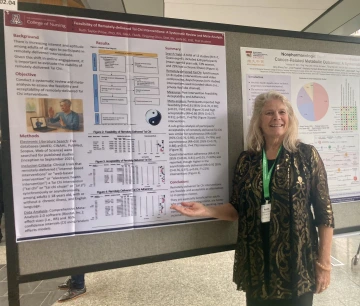
Professor Ruth Taylor-Piliae presenting at the Science of Tai Chi and Qigong as Whole Person Health 2026 Conference.
“That experience raised an important question,” Taylor-Piliae said. “Could Tai Chi be a more effective long-term exercise option for rehabilitation?”
Her research has since shown that Tai Chi can improve balance, flexibility, strength, quality of life, and long-term adherence to exercise across diverse patient populations.
Chen said that working closely with Taylor-Piliae, an internationally recognized expert in Tai Chi research, has provided her with valuable experience in research development and has shaped her long-term goals as a researcher.
“At the College of Nursing, we are committed to advancing innovative, evidence-based research that improves health and expands access to care for communities worldwide,” said Juyoung Park, PhD, MSW, FGSA, Interim NHS Division Chair and PhD Program Director. “Dr. Taylor-Piliae and Ying Chen exemplify this mission through their research, underscoring how mentorship, collaboration, and scientific discovery can shape healthcare’s future.”
“Over time, my experiences sparked a deeper interest in research and the evidence behind these interventions,” Chen said. “My long-term goal is to become an implementation scientist who translates evidence-based Tai Chi and Qigong interventions into clinical and community settings in meaningful, accessible ways.”
Both researchers hope to continue expanding access to evidence-based mind-body practices and to encourage healthcare systems and community organizations to integrate Tai Chi into wellness and rehabilitation programs. Future research will examine how these interventions can be adapted for additional populations and sustained over time in real-world healthcare and community settings.
What began as a familiar sight in neighborhood parks in China has now become the foundation of Chen’s growing career as a nurse scientist dedicated to making evidence-based Tai Chi and Qigong interventions accessible to communities worldwide.